Legal English: Patagonia, Pattie Gonia, and US trademark law
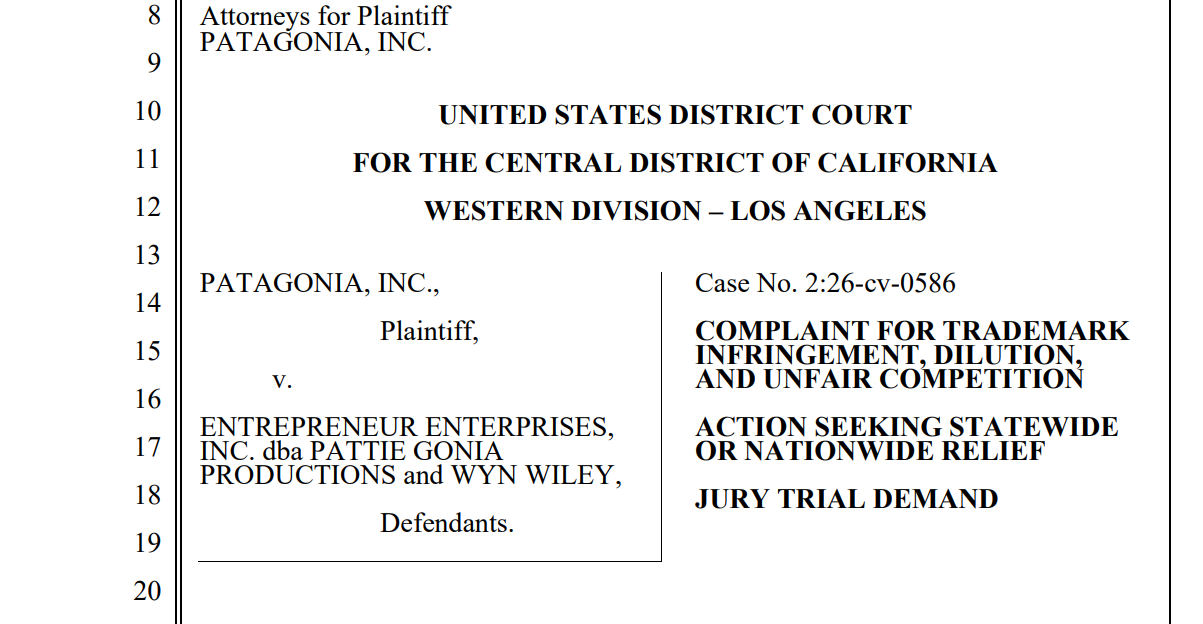
The famous retailer Patagonia made headlines this month by suing a drag queen, "Pattie Gonia." Patagonia accuses Pattie Gonia of trademark infringement, dilution, and unfair competition. This is a public relations nightmare for Patagonia, which has built its whole identity around an inclusive, environmentally friendly approach. What's going on in this case, and how did this lawsuit happen?
Background: Trademark in the US, Compared to the EU
Basically, a "trademark" is any identifier used by a business to distinguish its product or service from others. (15 U.S.C. § 1127) When you see the word "Patagonia" on a shirt, the trademark tells you who made that shirt. The trademark protects that guarantee of origin. It protects both businesses and consumers from frauds and copycats.
In the United States, trademark rights are not primarily created by registration — they arise from customary use. If you have been using a mark in your area to sell goods or services, you may have a legal right to prevent others from using a similar mark in the same geographic area. Registration with the U.S. Patent and Trademark Office strengthens that right nationwide by providing an exclusive right to distribute the goods or services listed under the trademark filing. The filing also allows you to use the registered trademark symbol, ®, instead of the general ™, which only asserts trademark ownership. (Congress.gov)
However, even an unregistered mark can be legally protected by "common law." This differs sharply from the EU system. With few, very narrow exceptions, the European Union follows a "first to file" system: whoever files a trademark application with the EUIPO first has superior rights, regardless of whether it has actually used the mark in commerce. (Lexology) The EU Trademark Regulation states explicitly that rights in a European Union Trade Mark "should not be obtained otherwise than by registration." (Lexology) In practical terms this means that a business can use a name in European commerce for years and still lose rights to it if a competitor files first. There is no EU-level equivalent of the US common law right: you cannot enforce an unregistered trademark across EU member states. (PatentPC)
The governing US statute is the Lanham Act of 1946, codified at 15 U.S.C. §§ 1051 et seq., but individual states have their own law for trademarks that don't fall under federal jurisdiction.
Infringement
In ordinary English, to "infringe" means to cross a line that you are not permitted to cross. The legal definition of "trademark infringement" specifically requires the use of someone else's trademark in a way that is "likely to cause confusion" between sources of goods and services.
Typically, courts do not require proof that anyone was actually confused: the standard is whether confusion is probable given the circumstances. How courts assess that probability varies by jurisdiction. Each regional circuit court of appeals has its own version of the test for "likelihood of confusion." New York federal courts apply the "Polaroid factors" (Polaroid Corp. v. Polarad Electronics Corp., 287 F.2d 492 (2d Cir. 1961)), while California federal courts apply the "Sleekcraft factors" (AMF Inc. v. Sleekcraft Boats, 599 F.2d 341 (9th Cir. 1979)).
This is where the Patagonia/Pattie Gonia case becomes interesting. "Pattie Gonia" is a pun on "Patagonia." That's the joke. So the legal question is not whether the names are similar, but whether a consumer could believe that Pattie Gonia's merchandise is produced by, affiliated with, or endorsed by Patagonia. In its complaint, Patagonia argues that confusion has already occurred — and backs this up with screenshots of real consumer comments on Pattie Gonia's social media posts, including one reading "I genuinely thought this was a Patagonia ad for too long… or is it?" and another addressing Patagonia directly: "Love you patagonia, you're amazing. Thank you for protecting our parks." (Complaint, pp. 4–5)
Dilution
"Dilution" is a separate and more powerful legal claim available only to owners of "famous" trademarks. A mark is considered famous if it is widely recognized by the general public as a designation of the source of the goods or services of the mark's owner. (Congress.gov) Think of marks like Coca-Cola, Nike, or, arguably, Patagonia.
In common language, to "dilute" something is to weaken it or reduce its value. Whiskey can be diluted by adding water. U.S. law recognizes two types of trademark "dilution." "Dilution by blurring" occurs when the distinctiveness of a famous mark is reduced by association with another mark. "Dilution by tarnishment" occurs when the reputation of a famous mark is harmed through such an association. (Cornell LII)
Dilution does not require confusion, or even the likelihood of confusion. It doesn't require competition, or proof of actual economic injury. The owner of a famous mark is entitled to a court order to prevent anyone from using a mark that's likely to dilute the famous mark. (Cornell LII) The governing statute is the Trademark Dilution Revision Act of 2006, codified at 15 U.S.C. § 1125(c).
Is Parody a Defense?
Pattie Gonia could choose to argue that their merchandise constitutes a parody of Patagonia's. A parody is a kind of "transformative" work that imitates another artist in an exaggerated way, with the goal of mockery, critique, or entertainment. Parody is a recognized defense in trademark disputes, but it doesn't apply in every case.
In the leading case, Louis Vuitton Malletier S.A. v. Haute Diggity Dog, 507 F.3d 252 (4th Cir. 2007), a company selling dog toys called "Chewy Vuiton" won against Louis Vuitton on both infringement and dilution claims. The Fourth Circuit affirmed that the "Chewy Vuiton" toys were not likely to cause confusion.
However, on the dilution claim, the court held that although parody can be considered a "fair use," the defense does not automatically extend to a parody that functions as a trademark in its own right. That distinction matters in the Patagonia case: "Pattie Gonia" began as a performance persona but is now the subject of a trademark registration application covering clothing and commercial services. That may shift it from safe "parody" toward a more vulnerable "designation of source." (The Fashion Law)
The Duty to Police, and the Perceived Obligation to Sue
This is the part of trademark law that's most commonly misunderstood, including sometimes by lawyers advising clients. No U.S. law requires a trademark owner to sue an infringer; however, a trademark can be lost by "abandonment."
The Lanham Act defines abandonment to cover three distinct situations:
The most straightforward is non-use: a trademark is considered abandoned if its use has been discontinued with intent not to resume such use. Non-use for three consecutive years creates a rebuttable legal presumption that the mark has been abandoned. (15 U.S.C. § 1127; Patent Trademark Blog)
The second route is "naked licensing": if the trademark owner fails to exercise control over a licensee, a court will find that the trademark has been abandoned because it constitutes a "naked license." (Justia)
Third, a term can become "generic": when a brand name becomes so dominant that the public uses it as the ordinary word for the product type — rather than as a particular company's product — it loses its protection. Words like aspirin, escalator, and thermos were all once registered trademarks, but each was eventually declared generic because the public had stopped using it to identify a source and started using it to identify a category. (Patent Trademark Blog; UC Law Review)
To prevent abandonment, trademark lawyers often advise their clients to send "cease-and-desist" letters — formal written demands to stop infringing activity — whenever they become aware of unauthorized use. A cease-and-desist letter creates a legal record that the owner objected and did not "acquiesce," or condone the unauthorized use. Sending a letter costs little, whereas ignoring an infringement can cost a great deal.
However, "policing" does not mean litigating. Licensing a trademark can also support trademark protection. A "license" is a permission granted by the trademark owner to a third party to use the mark under defined conditions. The important legal caveat is that licensing must be accompanied by genuine quality control: if the trademark owner fails to exercise control over a licensee, or does not provide for supervision in the licensing agreement, a court will find that the trademark has been abandoned because it is a "naked license." So a license is legally sound, but it must include real oversight provisions — not just a nominal fee and a handshake. (Justia)
A well-drafted license with clear scope restrictions — no use of the original logo or typeface, an explicit disclaimer of any affiliation, restriction to specific product categories — would protect the mark while permitting the licensed use to continue. Companies can also enter "coexistence agreements," in which two parties with similar marks agree on the boundaries of each other's use. These are common and legally unproblematic, and it sounds like Patagonia attempted to establish just such a relationship. But that doesn't always work.
Patagonia versus Pattie Gonia
In the Patagonia case, the outdoor retailer claims it attempted to come to terms with Pattie Gonia, but that the performer finally crossed the line, forcing it to defend its trademark. The complaint reproduces the correspondence in full. In February 2022 — when Hydroflask was planning a collaboration with Pattie Gonia and contacted Patagonia to check for objections — all three parties met, and Patagonia says they reached a clear understanding: Pattie Gonia would not use Patagonia's logos, would not use Patagonia's typeface (the "belwe font"), and would not use the Pattie Gonia name "in any form on product." (Complaint, p. 17) Pattie Gonia's production manager replied to confirm the arrangement. (Complaint, p. 18)
Three years later, Patagonia discovered a commercial merchandise website — pattiegoniamerch.com — selling branded apparel, including t-shirts and sweatshirts for a "Pattie Gonia Hiking Club." (Complaint, p. 2) Patagonia wrote again in February 2025 to invoke the 2022 understanding. Pattie Gonia's February 14 response disputed Patagonia's account of what had been agreed, characterizing the name as a geographic reference and the logo use as "fan art" that had "never been sold." (Complaint, p. 21) Patagonia followed up in March 2025; it received no reply. (Complaint, p. 20)
In the months that followed, Pattie Gonia restocked the merchandise line, launched a theater and arena tour under the Pattie Gonia brand, and — according to the complaint — continued displaying versions of Patagonia's P-6 mountain logo. At an Out Magazine event in November 2025, Pattie Gonia wore an outfit featuring a replica of the P-6 logo alongside the Pattie Gonia trademark. (Complaint, p. 24) At a TED Talk, she told the audience that many of them were wearing "my merch," then added that "Patagonia vests are indeed very TED drag." (Complaint, p. 24)
On September 21, 2025, Pattie Gonia Productions filed to register PATTIE GONIA as a trademark across five classes: recorded music, stickers and posters, clothing, marketing services, and live entertainment including motivational speaking in the fields of equality and environmentalism. (Complaint, p. 5) That application covers categories in which Patagonia itself holds registrations going back to 1974. A trademark registration, if granted, would create rights enforceable against Patagonia itself. Patagonia filed suit the following January.
It is worth noting that this is not the first time Patagonia has been forced to act against similar marks. The complaint lists prior enforcement actions against FRATAGONIA, CATAGONIA, PETAGONIA, PETROGONIA, and GATAGONIA — some from oil industry supporters, some from paramilitary merchandise sellers. (Complaint, p. 25) Patagonia's point is that consistent enforcement, regardless of the infringer's politics or values, is what keeps the mark legally defensible. Selective enforcement — suing the oil industry parody but letting the environmentalist one go — could itself become a legal vulnerability.
El famoso minorista Patagonia acaparó los titulares este mes al demandar a una drag queen, "Pattie Gonia." Patagonia acusa a Pattie Gonia de infracción de marca registrada (trademark infringement), dilución (dilution) y competencia desleal (unfair competition). Es una pesadilla de relaciones públicas para Patagonia, que ha construido toda su identidad en torno a un enfoque inclusivo y respetuoso con el medio ambiente. ¿Qué está pasando en este caso y cómo llegó a producirse esta demanda?
Antecedentes: la marca registrada en EE. UU., comparada con la UE
Básicamente, una "marca registrada" (trademark) es cualquier identificador utilizado por una empresa para distinguir su producto o servicio de los demás. (15 U.S.C. § 1127) Cuando ves la palabra "Patagonia" en una camiseta, la marca te indica quién la fabricó. La marca protege esa garantía de origen. Protege tanto a las empresas como a los consumidores frente a fraudes e imitadores.
En Estados Unidos, los derechos sobre una marca no nacen principalmente del registro, sino del uso efectivo. Si has estado utilizando una marca en tu zona para vender bienes o servicios, es posible que tengas derecho legal a impedir que otros utilicen una marca similar en la misma área geográfica. El registro ante la Oficina de Patentes y Marcas de EE. UU. (USPTO) refuerza ese derecho a nivel nacional, al proporcionar el derecho exclusivo a distribuir los bienes o servicios incluidos en la solicitud. El registro también permite usar el símbolo ®, en lugar del ™ general, que solo afirma la titularidad de la marca. (Congress.gov)
Sin embargo, incluso una marca no registrada puede estar protegida por el "derecho consuetudinario" (common law). Esto difiere radicalmente del sistema de la UE. Salvo excepciones muy limitadas, la Unión Europea sigue un sistema de "primera solicitud" (first to file): quien primero presenta una solicitud ante la EUIPO tiene derechos superiores, independientemente de si ha usado realmente la marca en el comercio. (Lexology) El Reglamento de Marca de la UE establece explícitamente que los derechos sobre una marca de la Unión Europea "no podrán obtenerse sino mediante registro." (Lexology) En la práctica, esto significa que una empresa puede usar un nombre en el comercio europeo durante años y aun así perder los derechos sobre él si un competidor solicita el registro primero. No existe en la UE un equivalente al derecho consuetudinario estadounidense: no se puede hacer valer una marca no registrada en todos los estados miembros. (PatentPC)
La norma federal aplicable es la Ley Lanham de 1946, codificada en 15 U.S.C. §§ 1051 y ss., aunque los estados individuales tienen su propia legislación para las marcas que no caen bajo la jurisdicción federal.
Infracción
En inglés corriente, to infringe significa cruzar una línea que no está permitido cruzar. La definición jurídica de "infracción de marca registrada" exige específicamente el uso de la marca ajena de una manera que sea "susceptible de causar confusión" (likely to cause confusion) entre las fuentes de bienes y servicios.
Por lo general, los tribunales no exigen prueba de que nadie haya quedado realmente confundido: el estándar es si la confusión es probable dadas las circunstancias. La forma en que los tribunales evalúan esa probabilidad varía según la jurisdicción. Cada tribunal de apelaciones de circuito regional aplica su propia versión del test. Los tribunales federales de Nueva York aplican los "factores Polaroid" (Polaroid Corp. v. Polarad Electronics Corp., 287 F.2d 492 (2d Cir. 1961)), mientras que los de California aplican los "factores Sleekcraft" (AMF Inc. v. Sleekcraft Boats, 599 F.2d 341 (9th Cir. 1979)).
Aquí es donde el caso Patagonia/Pattie Gonia se vuelve interesante. "Pattie Gonia" es un juego de palabras con "Patagonia." Ese es el chiste. Así que la cuestión jurídica no es si los nombres son similares, sino si un consumidor podría creer que la mercancía de Pattie Gonia es producida, afiliada o respaldada por Patagonia. En su demanda, Patagonia argumenta que la confusión ya se ha producido, y lo respalda con capturas de pantalla de comentarios reales de consumidores en las redes sociales de Pattie Gonia, incluyendo uno que decía "durante demasiado tiempo pensé que era un anuncio de Patagonia... ¿o lo es?" y otro dirigido directamente a Patagonia: "Te quiero, Patagonia, eres increíble. Gracias por proteger nuestros parques." (Demanda, pp. 4–5)
Dilución
La "dilución" (dilution) es una reclamación jurídica distinta y más poderosa, disponible únicamente para los titulares de marcas "famosas" (famous). Una marca se considera famosa si el público en general la reconoce ampliamente como designación de la fuente de los bienes o servicios de su titular. (Congress.gov) Piénsese en marcas como Coca-Cola, Nike o, posiblemente, Patagonia.
En lenguaje corriente, "diluir" algo es debilitarlo o reducir su valor. El whiskey puede diluirse añadiéndole agua. El derecho estadounidense reconoce dos tipos de "dilución" de marca. La "dilución por difuminación" (dilution by blurring) se produce cuando la distintividad de una marca famosa queda reducida por su asociación con otra marca. La "dilución por empañamiento" (dilution by tarnishment) se produce cuando la reputación de una marca famosa resulta perjudicada por dicha asociación. (Cornell LII)
La dilución no requiere confusión, ni siquiera la probabilidad de confusión. No requiere competencia ni prueba de un perjuicio económico real. El titular de una marca famosa tiene derecho a una orden judicial para impedir que cualquier persona utilice una marca susceptible de diluir la famosa. (Cornell LII) La norma aplicable es la Ley de Revisión de la Dilución de Marcas de 2006 (Trademark Dilution Revision Act), codificada en 15 U.S.C. § 1125(c).
¿Es la parodia una defensa?
Pattie Gonia podría optar por argumentar que su mercancía constituye una parodia de la de Patagonia. Una parodia es una obra "transformativa" que imita a otro artista de forma exagerada, con el objetivo de burlarse, criticar o entretener. La parodia es una defensa reconocida en los litigios sobre marcas registradas, pero no se aplica en todos los casos.
En el caso de referencia, Louis Vuitton Malletier S.A. v. Haute Diggity Dog, 507 F.3d 252 (4th Cir. 2007), una empresa que vendía juguetes para perros llamados "Chewy Vuiton" ganó contra Louis Vuitton tanto en la reclamación por infracción como en la de dilución. El Cuarto Circuito confirmó que los juguetes "Chewy Vuiton" no eran susceptibles de causar confusión.
Sin embargo, en cuanto a la dilución, el tribunal sostuvo que, aunque la parodia puede considerarse un "uso leal" (fair use), la defensa no se extiende automáticamente a una parodia que funciona como marca registrada por derecho propio. Esta distinción es relevante en el caso Patagonia: "Pattie Gonia" comenzó como un personaje artístico, pero ahora es objeto de una solicitud de registro de marca que abarca ropa y servicios comerciales. Eso puede desplazarla de la "parodia" protegida hacia una "designación de origen" más vulnerable. (The Fashion Law)
El deber de vigilancia y la percepción de la obligación de demandar
Esta es la parte del derecho de marcas que se malinterpreta con más frecuencia, incluso a veces por los abogados que asesoran a sus clientes. Ninguna ley estadounidense obliga al titular de una marca a demandar a un infractor; sin embargo, una marca puede perderse por "abandono" (abandonment).
La Ley Lanham define el abandono en tres supuestos distintos:
El más sencillo es el no uso: una marca se considera abandonada si su uso ha sido interrumpido con intención de no reanudarlo. El no uso durante tres años consecutivos crea una presunción legal rebatible de que la marca ha sido abandonada. (15 U.S.C. § 1127; Patent Trademark Blog)
La segunda vía es la "licencia desnuda" (naked licensing): si el titular de la marca no ejerce control sobre el licenciatario, el tribunal declarará que la marca ha sido abandonada por constituir una "licencia desnuda." (Justia)
El tercer supuesto es la genericidad: cuando un nombre de marca se vuelve tan dominante que el público lo usa como la palabra ordinaria para el tipo de producto — en lugar de como el producto de una empresa concreta — pierde su protección. Palabras como aspirin, escalator y thermos fueron en su día marcas registradas, pero cada una fue finalmente declarada genérica porque el público había dejado de usarlas para identificar un origen y había empezado a usarlas para identificar una categoría. (Patent Trademark Blog; UC Law Review)
Para prevenir el abandono, los abogados de marcas suelen aconsejar a sus clientes que envíen cartas de cese y desistimiento (cease-and-desist letters) — requerimientos escritos formales para que cese la actividad infractora — siempre que tengan conocimiento de un uso no autorizado. Una carta de este tipo crea un registro legal de que el titular se opuso y no "consintió" (acquiesced) el uso no autorizado. Enviar una carta cuesta poco; ignorar una infracción puede costar mucho.
Sin embargo, "vigilar" no significa litigar. Otorgar licencias sobre una marca también puede contribuir a su protección. Una "licencia" es un permiso concedido por el titular de la marca a un tercero para usar la marca bajo condiciones definidas. La advertencia jurídica importante es que la licencia debe ir acompañada de un control de calidad genuino: si el titular no ejerce control sobre el licenciatario, o no prevé supervisión en el contrato de licencia, el tribunal declarará que la marca ha sido abandonada por tratarse de una "licencia desnuda." Por tanto, una licencia es jurídicamente válida, pero debe incluir disposiciones de supervisión reales — no solo un pago nominal y un apretón de manos. (Justia)
Una licencia bien redactada con restricciones claras de alcance — prohibición de usar el logotipo o tipografía originales, una declaración expresa de ausencia de afiliación, restricción a categorías de productos específicas — protegería la marca al tiempo que permitiría continuar con el uso autorizado. Las empresas también pueden suscribir "acuerdos de coexistencia" (coexistence agreements), en los que dos partes con marcas similares acuerdan los límites del uso de cada una. Son habituales y jurídicamente no problemáticos, y parece que Patagonia intentó establecer precisamente ese tipo de relación. Pero no siempre funciona.
Patagonia contra Pattie Gonia
En el caso Patagonia, el minorista sostiene que intentó llegar a un entendimiento con Pattie Gonia, pero que la artista finalmente cruzó la línea, obligándole a defender su marca. La demanda reproduce la correspondencia íntegra. En febrero de 2022 — cuando Hydroflask planeaba una colaboración con Pattie Gonia y contactó con Patagonia para comprobar si había objeciones — las tres partes se reunieron, y Patagonia afirma que alcanzaron un entendimiento claro: Pattie Gonia no usaría los logotipos de Patagonia, no usaría la tipografía de Patagonia (la "fuente belwe") y no usaría el nombre Pattie Gonia "en ninguna forma en producto." (Demanda, p. 17) El director de producción de Pattie Gonia respondió para confirmar el acuerdo. (Demanda, p. 18)
Tres años después, Patagonia descubrió un sitio web comercial de merchandising — pattiegoniamerch.com — que vendía ropa de marca, incluyendo camisetas y sudaderas para un "Pattie Gonia Hiking Club." (Demanda, p. 2) Patagonia volvió a escribir en febrero de 2025 para invocar el acuerdo de 2022. La respuesta de Pattie Gonia del 14 de febrero rebatió la versión de Patagonia sobre lo que se había acordado, calificando el nombre como una referencia geográfica y el uso del logotipo como "arte de fans" que "nunca había sido vendido." (Demanda, p. 21) Patagonia hizo un seguimiento en marzo de 2025; no recibió respuesta. (Demanda, p. 20)
En los meses siguientes, Pattie Gonia reabastecieron la línea de merchandising, lanzaron una gira de teatro y recintos bajo la marca Pattie Gonia y — según la demanda — continuaron mostrando versiones del logotipo de montaña P-6 de Patagonia. En un evento de Out Magazine en noviembre de 2025, Pattie Gonia llevó un traje con una réplica del logotipo P-6 junto a la marca Pattie Gonia. (Demanda, p. 24) En una charla TED, le dijo al público que muchos llevaban puesto "mi merchandising," y añadió que "las chalecos de Patagonia son, de hecho, muy TED drag." (Demanda, p. 24)
El 21 de septiembre de 2025, Pattie Gonia Productions solicitó el registro de PATTIE GONIA como marca en cinco clases: música grabada, pegatinas y pósteres, ropa, servicios de marketing y entretenimiento en vivo, incluyendo charlas motivacionales en los ámbitos de la igualdad y el medioambientalismo. (Demanda, p. 5) Esa solicitud abarca categorías en las que Patagonia tiene registros propios desde 1974. Un registro de marca, si se concede, crearía derechos ejecutables contra la propia Patagonia. Patagonia interpuso la demanda el enero siguiente.
Vale la pena señalar que esta no es la primera vez que Patagonia se ha visto obligada a actuar contra marcas similares. La demanda enumera actuaciones previas contra FRATAGONIA, CATAGONIA, PETAGONIA, PETROGONIA y GATAGONIA — algunas de simpatizantes de la industria del petróleo, otras de vendedores de merchandising paramilitar. (Demanda, p. 25) El argumento de Patagonia es que una vigilancia coherente, independientemente de la ideología o los valores del infractor, es lo que mantiene la marca jurídicamente defendible. Una vigilancia selectiva — demandar a la parodia de la industria petrolera pero dejar pasar la ecologista — podría convertirse en sí misma en una vulnerabilidad legal.